



26.02.2025 12:24
The birth of a new life is a cherished happiness for many. However, it is worth understanding that expecting a child can be a challenging process for the body. In particular, varicose veins often develop during pregnancy. In this article, we will explain in detail how this condition progresses during pregnancy and its specific features.
Why Do Varicose Veins Occur During Pregnancy?
First of all, it is important to remember about hereditary predisposition. This means that if your mother, aunt, sister, or other close relatives had varicose veins, there is a risk that it may also develop during your pregnancy. It can also happen for a number of other reasons. As the baby grows, the uterus enlarges, pressing on the pelvic veins and slowing down blood circulation. Do not forget about:
hormonal changes in the body, such as increased progesterone levels and relaxation of venous walls, making them more prone to dilation;
an increase in blood volume during pregnancy, which puts additional pressure on the veins.
A sedentary lifestyle before and during pregnancy may also provoke varicose veins, as can the opposite – standing for long periods. It is important to maintain a balance of activity, eat properly, and never ignore the problem if it arises.
How to Recognize the Condition?
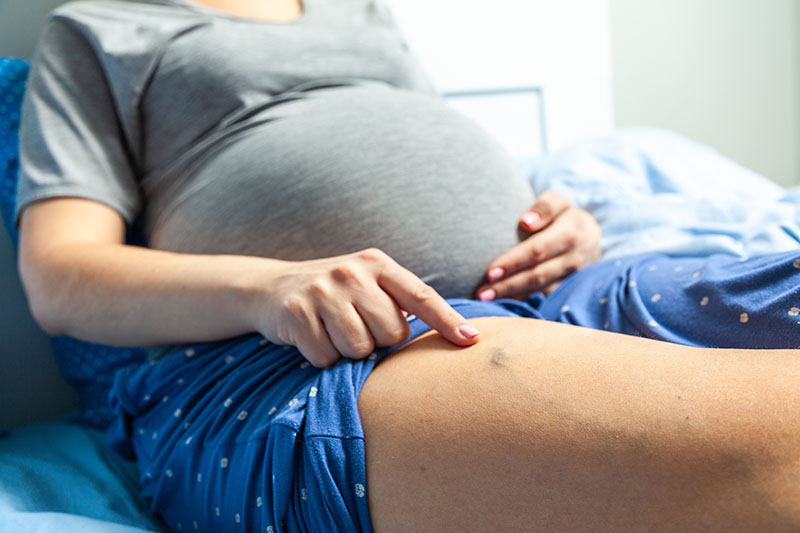
Only a phlebologist can accurately diagnose varicose veins in pregnant women. However, the expectant mother herself should also be attentive to her sensations and condition. The most noticeable sign is varicose veins on the legs, as the disease manifests in the form of vascular “stars,” venous clusters, or the formation of trophic ulcers. Itching and heaviness often occur where the veins are enlarged.
If we are talking about uterine varicose veins, it is much more difficult to notice the symptoms, since the condition can be confused with urinary tract disorders or cystitis. Signs that may indicate internal varicose veins include:
persistent heaviness in the lower abdomen;
urination problems;
pelvic discomfort when walking or even with light activity;
the appearance of uterine bleeding, etc.
Other possible symptoms include severe swelling of the body, pain in the perineum, and skin darkening in the groin. Unfortunately, women often ignore these signs, assuming they are simply side effects of pregnancy. We strongly recommend taking such symptoms seriously and consulting a specialist.
What Are the Risks of Varicose Veins During Pregnancy?
The main danger lies in the fact that the disease progresses as the fetus grows. In the early stages, symptoms may not even be noticeable, while during the second trimester the disease can progress to stage 2–3, with the appearance of nodules, spots, and ulcers on the body.
In later stages of pregnancy, varicose veins may advance to stage 4–5, leading to trophic ulcers that make movement difficult. Each stage poses different risks. For example, bleeding may occur, or placental insufficiency may develop in cases of uterine varicose veins.
What to Do if You Have Varicose Veins During Pregnancy?
Your first step is to see a specialist. If you need a phlebologist in Lviv, contact our clinic. The doctor will examine the enlarged veins, perform an ultrasound, and order tests. After a thorough examination, the specialist will recommend the necessary treatment for varicose veins.
However, keep in mind that therapy can only be carried out during certain stages of pregnancy – between weeks 7 and 8, 13 and 17, and between 23 and 28 weeks. At early stages, sclerotherapy may be used, where a special solution is injected into the damaged veins to “seal” them. This method can be applied both to the legs and other areas.
Other treatment methods will be selected individually after an in-person consultation and thorough examination. Do not neglect your health and the safety of your future child. By contacting our clinic, you will receive qualified medical assistance.
Preventive Methods
Prevention plays a very important role. Choose comfortable clothing and footwear. Clothes should not be too tight or fit the body too closely. You may also use compression garments, which help improve blood circulation and reduce stress on the veins.
Do not deprive yourself of physical activity. Swimming, yoga, and special exercises for pregnant women are highly recommended. Take care of your diet: eat a balanced variety of fruits, vegetables, bran, and nuts. Also, maintain proper hydration – it is recommended to drink at least 1.5–2 liters of water per day to prevent blood stagnation.

surgeon, phlebologist, ultrasound doctor
